What You Aren't Seeing by Patrick Sweeney
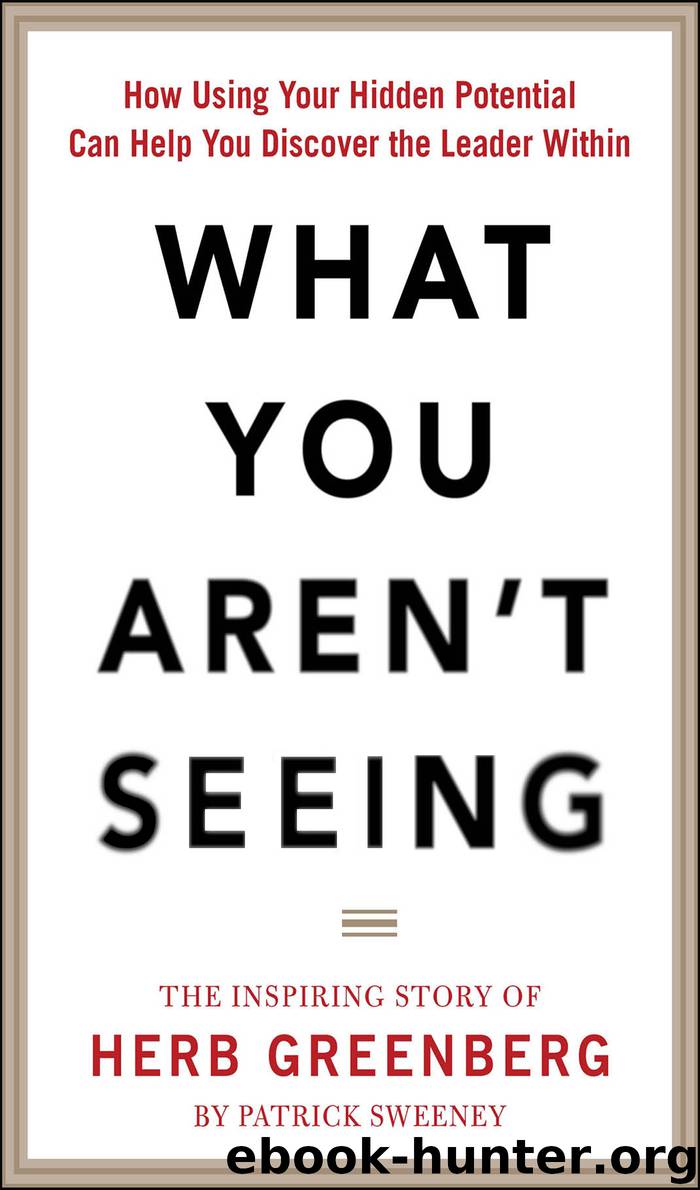
Author:Patrick Sweeney
Language: eng
Format: epub
Publisher: McGraw-Hill Education
Published: 2015-04-06T04:00:00+00:00
Lessons for First-Time Managers
Interestingly, as Herb and David hired their first employee, they both became managers for the first time as well. They found that supervising someone else is a new responsibility and provides more than a few new and interesting challenges.
Before Herb and David were both leaders and top performers in their organization—everything started and stopped with them. But now things were going to be different.
They needed to learn the fine art of managing.
While there are many books, articles, and seminars on what makes an effective manager, studies show that most people in management positions have little or no management experience or training before taking on their current role. In addition, according to the Bureau of Labor Statistics, more than half of workers who move up to supervisory, managerial, or executive positions came from other roles inside the same firm.
At the end of the day, a company’s productivity and ability to retain top performers depends largely upon the skills of its managers. But first-time managers often have misperceptions about what it means—and what it takes—to be a successful manager. There is a huge change in both mindset and behaviors when moving from doing work oneself to achieving results through the work of others.
“The most common mistakes of new managers tend to fall into two categories,” Herb says. “They are either too tough or not tough enough. It is a very difficult balancing act.”
Managers who are “too tough” in their approach to supervising others rely on their authority to get things done, Herb explains. “They might say, ‘I’m simply going to tell people what to do, and if they just do it the way I’ve always done it, they’re going to be fine.’ But it rarely works that way.”
On the other hand, managers who are “not tough enough” may feel uncomfortable with their new authority. They may be managing people who were formerly their peers and still want to be friends like they were before. But, when someone moves from peer to manager, the rules change. “They are now in a position where they have to hold not just themselves accountable, but others as well. And, sometimes they either don’t know how to do that or don’t want to,” Herb says.
“Among the most important lessons for a new manager is realizing that people don’t want to be told what to do and how to do it—they want to know ‘why.’ The people in your organization want to know they are part of something that is meaningful. Let them know how their assignment or project fits into the company’s larger goals and overall objectives,” he adds.
What are the personality attributes needed to succeed as a manager?
“You need to be bright enough to be able to think on your feet,” Herb says. “You also need to be assertive enough to be able to push an agenda forward. Of course, you need to be persuasive, so you can bring others around and create consensus. In addition, you need to be resilient enough to rebound from difficult situations that might arise.
Download
This site does not store any files on its server. We only index and link to content provided by other sites. Please contact the content providers to delete copyright contents if any and email us, we'll remove relevant links or contents immediately.
The Brazilian Economy since the Great Financial Crisis of 20072008 by Philip Arestis Carolina Troncoso Baltar & Daniela Magalhães Prates(373967)
International Integration of the Brazilian Economy by Elias C. Grivoyannis(111706)
The Art of Coaching by Elena Aguilar(53758)
Flexible Working by Dale Gemma;(23370)
How to Stop Living Paycheck to Paycheck by Avery Breyer(19845)
Thinking, Fast and Slow by Kahneman Daniel(12581)
The Acquirer's Multiple: How the Billionaire Contrarians of Deep Value Beat the Market by Tobias Carlisle(12443)
The Radium Girls by Kate Moore(12226)
The Art of Thinking Clearly by Rolf Dobelli(10751)
Hit Refresh by Satya Nadella(9283)
The Compound Effect by Darren Hardy(9183)
Tools of Titans by Timothy Ferriss(8635)
Atomic Habits: Tiny Changes, Remarkable Results by James Clear(8546)
Turbulence by E. J. Noyes(8242)
A Court of Wings and Ruin by Sarah J. Maas(8153)
Change Your Questions, Change Your Life by Marilee Adams(7952)
Nudge - Improving Decisions about Health, Wealth, and Happiness by Thaler Sunstein(7883)
How to Be a Bawse: A Guide to Conquering Life by Lilly Singh(7664)
Win Bigly by Scott Adams(7366)
